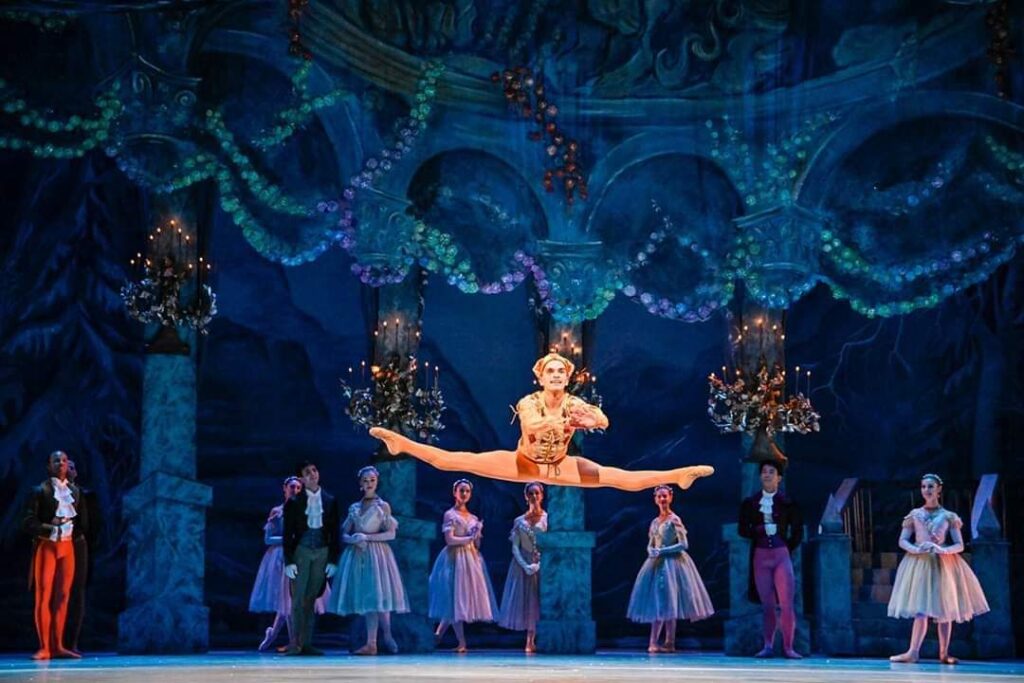
4dancers

Review: Joffrey’s “Spring Desire” Program

by Catherine L. Tully

Victoria Jaiani and Fabrice Calmels in Age of Innocence, choreographed by Edwaard Liang, Photo by Herbert Migdoll

Love, longing and sensuality are at the core of the Joffrey Ballet’s “Spring Desire” program which opened Wednesday night at Chicago’s Auditorium Theatre. The three neo-classical works on the program include the critically acclaimed “Age of Innocence” by Edwaard Liang, In the Night by the celebrated choreographer Jerome Robbins and the world premiere of Incantations by Val Caniparoli.

Set to the music of Philip Glass and Thomas Newman, Age of Innocence opens the evening with its tense, formal underpinnings—expertly juxtaposed with moments of passion and the yearning to express that which is in the heart. Maria Pinto’s thoughtful costume design cements the 18th/19th century vibe without being too literal, and enormous red velvet curtains are the only backdrop needed to evoke a formal ballroom atmosphere that is filled with both grandeur and repressed emotion.

To begin, the dancers dutifully line up, men on one side, women on the other. Hands extend and are accepted gracefully, but the hidden dialogue of which dancers long for one another remains frozen beneath the surface—cloaked in ritual. The First Dialogue sequence gives a first glimpse of that ache, when Jeraldine Mendoza and Mauro Villanueva suddenly find themselves involved a spinning, romantic match that transcends the rules of courting.

The next sequence, titled simply, The Men, is indeed a powerful display of manliness, executed with verve and confidence by Raul Casasola, Aaron Rogers, Ricardo Santos and Temur Suluashvili. The highlight of the piece, however, was most certainly Victoria Jaiani and Fabrice Calmels, who treated the audience to a riveting performance in the Obey Thee sequence.

April Daly and Miguel Angel Blanco in In the Night, choreographd by Jerome Robbins, Photo by Herbert Migdoll

Next up was In the Night, an enchanting look at love, choreographed by Jerome Robbins in 1970. This timeless piece consists of three pas de deux that explore relationships which are all in very different places. The backdrop provides a guide to the pulse of each pairing, with sparkling stars for young romance, formal chandeliers denoting a more guarded partnership and shooting stars to illuminate the tumultuous union that runs both hot and cold. More traditional in style than either of the other two pieces, this is Robbins at his finest, and the dancers rise to the occasion here. Set to the music of Chopin, pianist Paul James Lewis provided flawless live accompaniment for the piece.

Joanna Wozniak and Matthew Adamczyk in Incantations, choreographer by Val Caniparoli, Photo by Herbert Migdoll

As the curtain rose to reveal the world premiere of Incantations, a visual clue provided a hint as to what the audience was about to see. Hanging high on the right-hand side of the stage loomed a group of large spring-like fixtures that are reminiscent of beehives—a harbinger of what was to come in the choreography. Almost immediately, dancers began to flash across the stage with lightning speed, performing unusual sequences of movement—some of which are staggeringly difficult and wonderfully complex. Indeed, nearly the entire piece was infused with a buzzing, almost erratic energy that keeps building, lending a rather “showy” feel to much of the performance.

Occasionally there was a lapse in timing, yet all was immediately forgiven when the next cycle of intricate movements began. Some of the swirling motions seemed almost like a nervous habit after a while, but overall it was the continuous motion and energy that really took center stage. The music of Russian minimalist composer Alexandre Rabinovitch-Barakovsky and spectacular lighting design by Lucy Carter added both frenzy and focus to the work.

Although splendidly athletic, Incantations rides along the edge of being tiring for the viewer; but just when the piece threatens to overwhelm, release was finally granted through the absolutely glorious pairing of Joanna Wozniak and Matthew Adamczyk, which transformed the piece both in mood and motion. Here Caniparoli takes the dancers down from a mindless, wild energy to a softer exploration that still offers complexity paired with exquisite skill. The duet finishes in a seamless whirling motion that echoes the earlier chaos—but in a much more forgiving fashion.

Performances through May 6th at the Auditorium Theatre


Dance Spaces In Chicago, DanceBridge Program & More

If you are a Chicago-based dance artist or choreographer, this is for you.

4dancers spent some time looking into dance programs and spaces that are affiliated with the Chicago Department of Cultural Affairs & Special Events. We talked with Emmelia Halpern-Givens, Dance Programs Assistant at the Chicago Office of Tourism & Culture and she shared some great information about resources that those in the dance community here have available to them here…

Here is Emmelia with a closer look:

DanceBridge is our incubator program. We run 3 sessions a year (Winter, Summer and Fall) and send out an open call to Chicago based artists/companies, then pick between 2 – 3 artists each session. They’re given 3 months of space to work, followed by 2 nights of an informal showcase where they split profits between themselves and our box office. The work is usually an excerpt or a work-in-progress, and we offer lighting and sound as well as room for about 85 people each night.

I think it’s an awesome program because it’s free space! Plus, it allows lots of artists opportunity to be in that space, whether as a choreographer or a dancer. Also, because it’s at the Chicago Cultural Center which is a public building, I think it offers visibility to new audiences who just kind of walk in the night of the showcase and decide they’re here, so why not see the performance? I think the accessibility of the space is a great benefit to the program itself.

The dance studio is on the first floor (Randolph entrance) and overlooks Michigan Ave/Millennium Park… could you ask for a better view? Nothing better than walking through the park after rehearsal.

It also has marley floors and thick walls. In terms of privacy in a public building, it holds up well. It has one glass door on the south side and we have a folding screen in the studio to for artists to move if they feel it necessary, otherwise you’re generally on your own.

We also have 2 application based programs for the theater department.

Our studio theater, which is located in the Chicago Cultural Center runs an incubator program where companies get the space for a month and then perform in a one night showcase at the end. Again, like the DanceBridge program, the performances are generally pretty bare bones but still get great turn outs and we’ve had companies do incubators and several years later make it into the Storefront theater for a 6 week run. (Striding Lion Performance Group performed in this programming in 2009.)

Our storefront theater is just across the street in the Gallery 37 building, it’s a 99 seat black box that presents between 8-10 companies a year. Companies get between 3-6 week runs. This year we have Chicago Dance Crash doing a 6 week run in our space followed by Khecari doing a 3 week run. For dance companies, that’s huge! The reviews will have time to land before the run closes.

For more information about these programs/spaces, visit the DCA Theater website.


One Dancer’s Journey: Performing Arts As A Profession

Todd Fox returns with the next installment of “One Dancer’s Journey” — if you haven’t had the chance to read the other posts by Mr. Fox, you can find them here.

by Todd Fox

Todd Fox


5. What have you had to struggle against in dance?

I didn’t experience an overwhelming amount of ridicule in public school as a boy studying ballet but I did hear my share of jokes and was teased often. At first the teasing didn’t really bother me because I was obsessed with learning ballet and I didn’t really care what people thought—but you can only ignore things for so long.

It all came to a head pretty quick one day in 9th grade when a student was teasing me and called me a name so I punched him square in the face causing a bad nose bleed. I was promptly suspended from school and my parents completely freaked, it was definitely NOT the proper or mature way to handle the situation but I was 15 at the time, it happened, and I was never teased again.

Teasing and name calling aside, I think the number one thing I have had to struggle against as a professional ballet dancer here in the United States is the perception of my life’s work as some sort of contribution to a non-essential charity, as if it has no value in the “real world”.

Read more

Dance Blog Spotlight: The Choreography Clinic

We’re back with another edition of “Dance Blog Spotlight” – and the blog this month focuses on choreography…

1.      Can you tell readers a bit about your background in dance?

I started dancing with a praise dance company, The Hush Company, under the direction of Stacy and LaQuin Meadows. I danced with them for 8 years and knew that dance was what I wanted to do for the rest of my life. I didn’t start studying ballet and modern until I was 18 years old. I have a BFA in Dance Performance with a K-12 Certification from Towson University in Towson, MD. I now teach full-time at a performing arts high school in downtown LA: Ramon C. Cortines School for the Visual and Performing Arts.

2.      When did you begin your blog-and why did you start it?

I began The Choreography Clinic in November 2011. I started it because I don’t have time to get my MFA right now and I missed those in-depth conversations about process that you only seem to find in college dance programs. I am sure you can find them other places as well but I wasn’t finding them where the access was free and open. I have lots of books on choreography but they didn’t give me the kind of interaction  and reflection that I was craving. I also wanted an opportunity to talk with other choreographers who were as interested in process as I was and find out how they were navigating their own artistic processes.

This idea came to me over a year ago, but I was really nervous at first that no one would be interested. No one knew who I was. I had not produced any work publicly and sometimes dance can be very clique-ish. I finally got up the nerve to go forward with the project and found myself in conversations where I was hearing that this was something others wanted as well. Geography is a huge problem for people who want that interaction, so online has provided a wonderful way to interact without the drama of having to “get to” somewhere to get it.

3.      What does your blog cover?

Read more

Book Review: The Cranes Dance

by Emily Kate Long

Meg Howrey’s novel The Cranes Dance (Vintage Contemporaries, on sale May 15) is the twisted portrait of New York ballerina Kate Crane, as told from Kate’s point of view. She is funny, stubborn, jaded, guilty. She is a dancer. She has a sister. She lies to herself. She questions her own sanity. She is trying to decide what she wants and who she should be. Even when I didn’t like her, I still liked her because I knew her. Reading this novel, I felt about Kate the way you would feel about your sister or a longtime friend, which is appropriate considering Kate’s love/hate/jealousy/admiration/guardian/saboteur relationship with her younger sister Gwen.

The reader is plopped down right in the middle of what turns out to be a pivotal season in Kate’s career. Howrey opens her novel with a hilariously irreverent description of Swan Lake: “…here we are in the Village Green of Wherever filled with people who like to greet each other maniacally every ten seconds and then in walks Prince Siegfried…” Kate’s description is that of someone who has become disenchanted with ballet’s magic on the one hand but on the other hand cares desperately about her work, although she isn’t always sure why.

We are introduced bit by bit to Kate’s sister Gwen, though Gwen as a character is never fully fleshed out. Kate alludes to Gwen’s final breakdown, at which point Kate feels compelled to call their father to take Gwen back home to Michigan where she is treated for an unidentified psychological condition. As the story progresses (related as Kate’s day-to-day mixed with flashbacks and background information concerning the events leading up to Gwen’s departure) Kate’s world is turned upside down with each discovery she makes about her role in her sister’s breakdown, her own mental state, and whether or not any of her relationships actually matter.

Read more

Global Dance Network

by Jessica Wilson

Global Dance Network has just been launched after a two year build as a huge social networking site for all styles of dance worldwide, from ballet to street dance. In an incredibly powerful yet easy to navigate resource, GDN holds a multitude of dance-related articles, reviews, a jobs and auditions recruitment system, an online dance context, details of dance events, forums, discount coupons and more. The founders of GDN advocate the enormity of the site as partly social network, part information platform, part interactive dance contest, encompassing everything dance-related for the dance enthusiast, student and teacher.

As a virtual dance community, GDN has become the host of the ultimate features of a dance website through the evolution of a social networking site to provide more for its users. The website justifies a multitude of reasons for dancers to spend even more time communicating about dance on considerably more levels than has been achieved previously, without losing sight of the dance aesthetic. The huge achievement that has emerged as the result of the building of the GDN emphasises, now more than ever, the vast importance of keeping the dance spirit alive for now and the future.

A main feature of the new site is the incredibly interactive dance contest, the “Global Dance Chart” competition. Members of the GDN site can enter a video of themselves dancing in any of the fourteen categories, which immediately goes live on the site.  Other users and even the general public can then vote for videos, with votes displayed in real time. The player can be used like a television, allowing users to flick between dance channels, styles and videos whilst voting. The creators of the GDN aim to make this the best real time dance contest anywhere on the internet, representing their huge investment into the site.

Read more

Top Dance Apps Of 2012

Today we have a guest post by Jane Johnson who is going to share 5 fun dance apps she has come across…

Salsa, break dance, tap dance, ballet, tango, cha-cha-cha, swing dance…even though there are hundreds of different types of dance, dancers represent a true niche market audience as far as smart phone apps go. However, did you know that novice and veteran dancers alike can use their mobile devices to look up how to do a proper shoulder groove in break dancing as fast as they can check movie times?

When my daughter first started ballet 5 years ago, I never anticipated downloading smart phone apps for her to use between rehearsals. However, the dance apps that are available for mobile devices are really quite impressive.

As the mom of a prima ballerina (at least in my eyes), here are the top dance apps of 2012:

Read more

Brooklyn Ballet: Revolutionaries and Romantics

Brooklyn Ballet’s 2012 season, “Revolutionaries and Romantics” is currently underway, and it includes a performance at the Kumble Theater today, Friday, April 13th. We corresponded with Artistic Director Lynn Parkerson about live music, different dance styles and more. Here’s a behind-the-scenes peek…

Photo by Julie Lemberger

The project started with a conversation with Kumble Theater Director, Rodney Hurley. He wondered what kind of program Brooklyn Ballet would create to illuminate major influences in classical ballet at the turn of the century ca.1890-1920. My first thought was Isadora Duncan and the Russian ballet. Research suggests that Isadora had a profound influence on classical ballet. Michel Fokine, Anna Pavlova, Sergei Diaghilev were all mad about her performances. I was curious about the structural and artistic ideas of both Duncan and Fokine and sought to interweave Duncan’s Chopin Waltzes and Fokine’s Les Sylphides. I found wonderful similarities and harmonious contrasts, a dance of great ghosts. She is the Revolutionary, he is the Romantic. Her courage gave life to his romantic ideas heretofore suppressed by the constraints of the Russian Imperial Theater. There are other tie-ins to the theme. Isadora’s own work plums the depths of love and her Chopin Dances are all about romantic love. Isadora’s powerful Revolutionary Etude, one of her last works, expresses like no other work the spirit of Revolution.

Photo by Julie Lemberger

I like the way different dance styles connect with each other even though they are seemingly quite different. I like to find connections, then expand on them as opposed to fusing two styles. For example, when I add three African-based modern dancers to The Marzipan Dance from The Nutcracker, the dancers remain in separate opposing diagonals, the choreography of the ballet dancers, spiky, light and vertical, the choreography of the modern dancers low-slung, lateral, weighted. They dance in unison nonetheless, a rhythmically-related flirt fest!

I’ve also been working with pop and lock dancers since 2005, collaborating primarily with Michael “Mike Supreme” Fields. In this season our departure point was Stravinsky’s “Suite Italienne.” What is so interesting is how the “pop and lock” dancers respond to the Stravinsky in such a directly personal way. The ballet dancers, on the other hand, have step material through which the music is interpreted more abstractly. Still, when performed all together the dancers are characters on the stage, relating to each other in their given forms. The ballet dancers are at times improvising and the “pop and lock” dancers are choreographing. Both sets of dancers are exploring new territories.

Photo by Julie Lemberger

A whole world, of human interaction, of sound coming from human hands on acoustic instruments. The musicians–violinist Gil Morgenstern, director of The Reflection Series, and pianist Julius Abrahams–are world class. Their music soars and gives the dancers such a ground to dance on and an energy that changes from minute to minute, is slightly unpredictable, that forces the dancers to interact.

What is next for Brooklyn Ballet?

Next season I’d like to create a work that uses digital technology to map out floor patterns of the dancers in real time. I want to reveal the conscious use of space that I and all choreographers use as we create. Choreographers don’t take space for granted. I want to let the audience in on this. Music choices will include Harpsichord works by Louis and Francois Couperin. It is also Brooklyn Ballet’s 10th year anniversary so we’ll be celebrating our education and outreach programs as well.

BIO: Lynn Parkerson, Founding Artistic Director of Brooklyn Ballet, began ballet studies as a child with Barbara Bounds in Chapel Hill, NC. She later danced with the Boston and Chicago Ballets, performing many Nutcrackers and Balanchine ballets. In New York City, she was a trainee at the Harkness House for Ballet Arts and on scholarship at the Merce Cunningham School, where she studied technique and learned repertory. In addition, she trained in the Limón Technique with Libby Nye and ballet with the Corvinos. From 1986 to 1996, she performed the repertory of Isadora Duncan as interpreted by Hortense Koulouris and Julia Levien.

Ms. Parkerson began to choreograph while living in Munich, Germany, dancing with Birgitta Trommler’s TanzProject Munchen. Her work has been presented at many promi- nent international events and venues, including the Munich Theater Festival, Frankfurt’s Theatre am Turm, the Florence International Festival of Dance, Moers New Jazz Festival, Jazz Festival Baden-Baden and An Appalachian Summer Arts Festival in Boone, NC, among others. In New York City, she presented annual dance programs—notably the popular ballet series To the Pointe—as Director of Dance at Holy Trin- ity from 1991-2001. Her work has been supported by grants from the Harkness Foundation for Dance, Joyce Mertz-Gilm- ore Foundation and Con Edison. She was on the faculty at the 92nd Street Y Harkness Dance Center from 1989-1996 and then served as its Assistant Director from 1996-1999. Ms. Parkerson has taught dance, improvisation, and choreogra- phy to children and adults in New York and abroad.

In recognition of her exceptional leadership contributions to Brooklyn’s cultural community, Ms. Parkerson received the Betty Smith Arts Award as part of the Women’s “Her- story” Induction Ceremony and Reception in 2007. Each year, the awards, named after some of the most outstand- ing women in Brooklyn “herstory,” are presented to six Brooklyn women. In 2006 she received the Paul Robeson Award for Artistic Excellence and Community Service.


The Joffrey: Spring Desire Affinity Night

JOFFREY DANCERS: CHRISTINE ROCAS AND MAURO VILLANUEVA | PHOTO BY: SANDRO

4dancers is delighted to announce a partnership with the Joffrey Ballet and Vicki Crain of Rogue Ballerina!

Spring Desire Affinity Night will take place at Joffrey Tower on Wednesday, May 2nd. This is a totally FREE evening where you will get to see the Joffrey perform excerpts from the Spring Desire program, followed by a Q&A session with Artistic Director Ashley Wheater. Stay for cocktails and hors d’ouervres, mingle with fellow dance lovers and get an inside look at the space that the Joffrey calls home.

This is the perfect opportunity to bring a friend and let them experience the Joffrey for the first time–and all attendees will receive 50% off on tickets* for the final weekend of Spring Desire at the Auditorium Theatre of Roosevelt University.

*Offer not valid on previously purchased tickets.  (Please note: attendees are NOT required to purchase tickets.)

Interested? There are still spots available, but be sure to act quickly–seating is going fast for this spectacular event–and you must RSVP to attend (see below).

Here’s the info:

Wednesday, May 2

Joffrey Tower10 East Randolph Street, Chicago
5:45 pm Registration
6:00 pm Program and Q&A
7:00 pm Cocktails and Hors d’ouevres

To RSVP, please email affinity@joffrey.org or call 312-784-4640. Provide your name and the number of people you will be bringing to the event no later than April 25th.

Both Vicki and I will be there–so if you can make it be sure to say hello!

Please share this post with anyone you think would be interested — it really is a great opportunity to introduce someone to ballet–

Hope to see you there,

Catherine

Choreographer & Dancer: A Personal Relationship?

Last week we ran an interview with Margi Cole about choreography and her upcoming showcase, which features dancers from her company making their own dances. Today we highlight both the dancer and the choreographer, to give you a closer look at the overall process.

Kaitlin Bishop is the choreographer here, and she has created a solo delving into the basic human emotion of sadness. The piece looks at how early childhood experiences with sadness dictate its existence (or lack thereof) in our adult lives and how we react to it, in it and through it.

Kaitlin Bishop

Here are some of Kaitlin’s thoughts on the piece….

Where did the idea for this piece come from?

I think the idea for this piece has been slowly incubating in the back of my brain for a few years now. The work I’ve choreographed in college and for TDC is always rooted in a journey, be it a journey I’ve completed or a journey I’m currently experiencing. I’ve always been a very introspective person, keeping a journal even as a very young child, so thinking about and acknowledging my feelings is second nature, however, as I’ve gotten older, and have recently gotten married, I’m now not only recognizing emotional states but  I’m really starting to analyze them, their range and scope, and question the true cause of them – if there is one. Sharing my daily life with another person has really been pretty fascinating in that I now have a witness to my daily emotional experience – someone who makes observations and asks questions, in a way forcing me to articulate how my internal thoughts & emotions manifest themselves externally.

Is there a reason you chose to make it a solo piece?

The idea and experience behind this piece is so personal, not just for me, but for Maggie, and essentially for every person who has ever experienced feeling sad. Everyone relates to sadness (and its varying degrees) so differently. Sadness is such a singularly personal and internal experience and journey, I couldn’t imagine attempting to capture that in anything other than a solo piece. When I watch dance, I’m always looking at and responding to the relationship between the dancers. When I see a (good) solo, I see a person existing in space, inhabiting their experience for me bear witness. I think if I added another person to that space, it would become about something else – not just this single person’s experiences within herself.

What was it like to choreograph this work?

It’s actually been very energizing and exciting in the process so far. Maggie and I have such an open and honest dialogue about our respective experiences of sadness (and causes thereof) in our lives, and also through this process, how ideas are being manifested physically and visually, etc. It’s pretty exciting to go into a rehearsal and have absolutely no reservations or fear about what we might discover, either in the work or in ourselves.

Can you explain your process?

We started rehearsing in the beginning of March, but we started discussing the piece in January. I had a (long) list of questions I created based on my own experiences throughout my life, questions I’ve been asked myself, conversations we’ve had in the past, etc, for Maggie to answer that served as the jumping off point for this whole process.

From there, we just kept making observations and asking more questions and having more e-mail conversations, until I went back and extrapolated the ideas, phrases, and stories that really resonated with me. Bringing those discussions into the movement invention process has involved a lot of improvisation and movement investigation, teaching each other our movement vocabulary, stripping it down, and then building it back up. I create work similarly to how I write: with the overall framework of what I want to convey set, and then allowing the movement vocabulary to develop and flesh out the experience, making changes and going in new directions as the process and underlying ideas dictate.

Prior to this—what experience did you have with choreographing dance?

Having grown up teaching and choreographing dance in a typical studio setting (jazz, tap, ballet, etc), I graduated college a little burnt out on the idea and not really interested in pursuing my own choreographic opportunities to any great extent. Working in a collaborative environment with The Dance COLEctive really satisfied that urge for the past several years too. I created a work for last year’s COLEctive Notions concert when I challenged myself to do something that scared the crap out of me and had such a great time, it really seemed to light a little fire in me. Plus, it would just  be silly to pass up the opportunity and resources that Margi’s giving us in this process. It’s incredibly rare to be given the space, time, and energy that Margi’s giving us to do this.

What was it like to choreograph for Maggie?

Choreographing for Maggie is 90% of  the fun. We have such a special friendship, and that has really served as an incredible foundation for the piece we’re creating together. To be able to so openly delve into our thoughts, feelings, and experiences and then really explore a physical embodiment of those discussions has been incredible. There’s no one I trust with this piece more than Maggie, and it’s actually been a great learning experience for me as well, to listen to her own thought processes and ideas as we’ve investigated movement ideas and such. It just adds to the personal reward of creating when there’s so much reciprocity with the dancer embodying the work, especially given the sensitive and personal nature of the subject matter. I don’t think there’s any fear or insecurity in this process for either of us, which makes it all the more exciting.

How would you characterize the entire experience?

So far, the experience of creating this piece has been amazing. The discussions, the discoveries, the challenges, have been so fun. What I think will be interesting (and slightly scary) to see will be what it’s like to have this piece viewed by others. Right now, Maggie and I have this very open and safe space we’ve created for each other in this process, and I’m very aware of the fact that at some point, others will see this, will see me, essentially, and the ideas behind this work are so incredibly personal for me, it’s more than a little terrifying to have it available for public consumption.

And now for a perspective from the other side…the dancer, Maggie Koller, talks about what it was like to work with Kaitlin…

Maggie Koller

What did you think of the choreographic process for this solo piece?

I found the process to be very interesting! When Kaitlin views dance, she finds herself more appreciative of work that gives her time to establish an emotional connection with the dancer(s) on stage. So, we’ve spent a lot of time creating the sort of normal, day-to-day personality and movement vocabulary of the character to help the audience connect with this person before we ask them to be with her while she finds herself in more compromised emotional states. Kaitlin also has a very interesting view of space and how she (or the work) applies meaning to the various areas of the stage. I was in the quartet she set on TDC last year, so I’ve gotten to work with her in this capacity before. This process has been even more fascinating for me because it’s just the two of us! I get to see more deeply into her head and understand her unique points of view on dance making.

What was the most difficult part of the process for you?

Perhaps this is an obvious answer, but I think the fact that this work is a solo makes it challenging. After being in the company for 6 years, Kaitlin and I are well versed in the “Margi style,” which includes a great deal of partnering and relationship development. In a solo, you don’t have anyone else to build a relationship with, so we’re really having to work to tell the story with a single body in space. Secondly, that single body is mine! So I am fully responsible for communicating Kaitlin’s vision, and it’s really important to me to bring that vision to life.

What was the most fulfilling part?

Probably a combination of the subject matter and the development of  the work as a solo. The span of negative and positive emotions people experience, whether as a reaction to events or encountered habitually, is something Kaitlin and I have spent a lot of time discussing over the course of our friendship. It’s been really interesting to continue those discussions with an end goal of translating our thoughts and experiences into movement for her work. I am also finding this solo process to be quite satisfying. I really appreciate being put in a position where I’m expected to manifest such specific requests and corrections. Every breath, focus change, direction of energy, and the force I put into each moment has been analyzed and dissected repeatedly by both of us to make sure the way I move is true to Kaitlin’s vision and true to the emotional states we’re exploring.

What was it like to work with Kaitlin as a choreographer?

I love working with Kaitlin! She and I are really great friends and share a unique connection as human beings, so having this time and space to work together has been truly wonderful. I really feel comfortable moving in front of her and am totally open to her feedback. Analyzing, emailing, journaling, and talking about all that we’ve explored to get to where we are with the work has been very engaging. I’m honored that she trusts me with her vision.

BIOS:

Maggie Koller received interdisciplinary dance training at the Academy of Movement and Music in Oak Park, Illinois. She earned her BA from Beloit College with a double major in Dance and Psychology, graduating with departmental honors, Summa Cum Laude. Maggie is currently in her sixth season with The Dance COLEctive (TDC). She has also danced with Chicago-based companies The LIVE ANIMALS Performance Collective, Ayako Kato/Dance Union, and The Space/Movement Project (TS/MP), for which she acted as co-director and CFO. Maggie has choreographed for TDC, TS/MP, The Open Space Project, The Inconvenience, OPRF’s Orchesis, and is involved in an ongoing performance collaboration with musical artist AM Brother. Maggie also has a full-time position as a Creative Planner for Central Coast Agency, a creative think tank for advertising, content, user experience, and design.

Kaitlin Bishop came to Chicago in 2002 to pursue her dream and passion for dance. A graduate of Columbia College Chicago with a BA in Dance, Kaitlin has had the privilege of working and performing with such dance makers as Krenly Guzman, Nicolle Wood, Molly Shanahan, Angie Hauser, Colleen Halloran, Jeff Hancock, Sandra Kaufman and Liz Burritt. Kaitlin also serves on the Board of Directors and heads the Fundraising Committee of The Big Hearts Fund, a non-profit organization dedicated to raising funds for canine and feline cardiac disease. This is Kaitlin’s sixth season with The Dance COLEctive and she thanks her family and friends for their unwavering love and support.