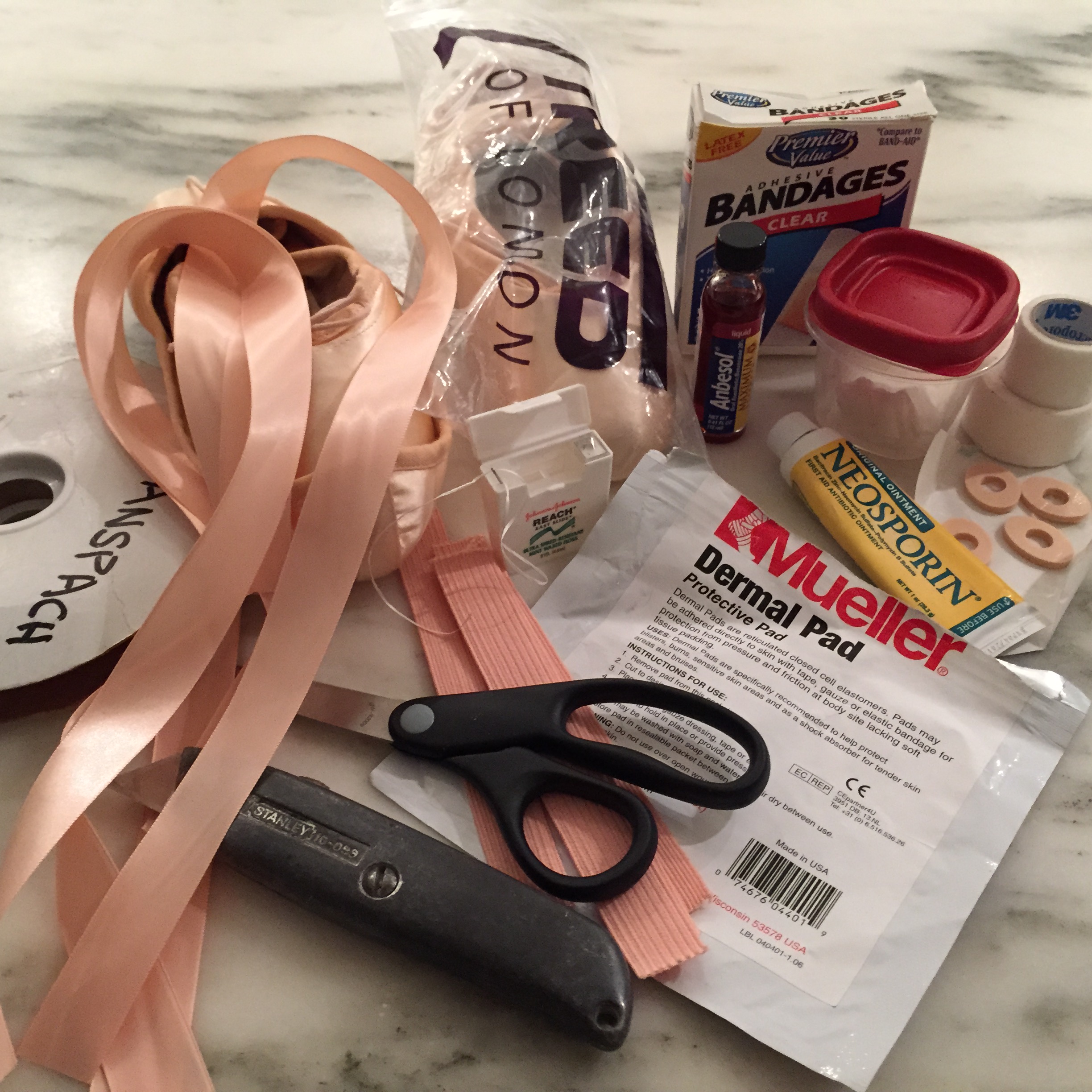
Pointe Shoes
Pointe Shoe Products: Daniel’s Pointe Shoe Glue
Cassady from Motion Unlimited Dancewear is back with us today to talk about another pointe shoe product–pointe shoe glue…
Everybody knows pointe shoes are expensive! For most people, it’s important to try to preserve them as long as they can. There have been many tricks out there, but the best seems to be gluing them. Of course you can use many types of glue, but the very best has to be Daniel’s Pointe Shoe glue.
Daniel, the man who invented it, did a lot of research on pointe shoes and came up with a great formula designed specifically for dancers to repair, restore and renew dead pointe shoes. You can use the glue in a variety of ways to help harden and uphold your shoes.
Most commonly, dancers will put the glue on the areas of their shoes that become soft. To get the best results, you have to let your shoes dry completely after wear. After they dry, you just apply the glue to the soft areas inside or outside of the shoe and again let them dry completely. Even though this glue seems like magic, it will not make your shoes brand new again–but it will give you the ability to continue to wear them for a while longer.
Another way to use help extend the wear of your shoes is to use the glue before you dance in them. Take your brand new shoes (before any wear) and put glue on the areas that tend to “die” quickly. This will add an extra hardness to the areas that seem to need it, giving your shoes more life. As they soften, you can always re-apply more glue.
Keep in mind, if you are newer to pointe work, you’ll want to get your teachers advice before trying to glue your shoes on your own. You don’t want to ruin a pair of pointe shoes!
Save your shoes–try Daniel’s Pointe Shoe Glue.
The History & Making Of Freed Pointe Shoes
In the late 1920’s, Frederick Freed left England’s leading pointe shoe manufacturer (along with his wife and one assistant) to set up shop in a small basement, making shoes of their own. Over time, his reputation for producing quality shoes increased, as did the demand for his shoes. This took the Freed brand to the forefront of the industry where it remains one of the most respected shoes among ballet dancers worldwide. Amazingly, after all these years The Freed of London Shop is still located at the same address.
There is something to be said for tradition.
Today over 250,000 pairs of Freeds are made every year, and they are sold in over 50 countries. Every one of them is hand-crafted by a Professional Pointe Shoe Maker, each of which makes between 30 and 40 pairs daily. Makers shape their shoes in a unique way and they are identified by their own personal stamp on the bottom of the shoe. Symbols include letters, a key, a heart and a Maltese Cross, among others.
Emily Starling: On Breaking In Pointe Shoes
by Emily Starling
Pointe shoes are a type of shoe used by ballerinas across the world and they enable the dancer to dance ‘on their toes’. There are many different makes, some of the most popular being Bloch, Freed and Gaynor Minden. A ballerina chooses the shoe which best suits their foot shape and range of movement of the foot itself.
Like many other types of shoe, pointe shoes must be broken in before they are worn but, rather than for comfort, this is a must for dancers in order for them to be able to perform at their best.
There are many ways of doing this some working better for certain dancers than others but in my opinion there are two stages to this process:
Making the sole flexible.
Manipulation of the toe section.
The sole must be flexible so the ballet dancer can perform all her moves to the best of her ability as well as being aesthetically pleasing to the eye. The toe section must be manipulated so the whole foot can be used with ease.
I personally use my hands to make the sole supple, having had years of experiencing different types of shoe and how the shoe feels on my foot I know to which degree I can bend them in order for me to execute all my movements with precision. This for me is the quickest and easiest method.
Manipulating the toe section is more time consuming and requires the shoe to actually be on the foot. Normally a couple of nights before I will wear them I place them in a warm place such as the airing cupboard. Then the night before I put them on and walk around my house for 15 – 20 minutes on demi pointe and do slow rises until I am happy that I can get from demi pointe to full pointe and back again with ease. The enables my feet to move freely–as close to how they would feel in flat shoes as possible. Finally, I place them back in the airing cupboard overnight so as not to undo the work I have done with them.
About the dancer: Emily Starling is 20 years old from Essex, England. She has recently graduated from Bird College in Kent, with a Diploma in Musical Theatre. Predominantly ballet-trained, Emily has been a member of Chelmsford Ballet Company for 9 years, and has recently become an Associate of the Royal Academy of Dance in London.
Stay tuned for more dancers talking about how they break in their pointe shoes as we continue our “focus on pointe” this month!
0Pointe Shoe Products: PrimaSoft Stretch Ribbon
Since the focus for this month is on pointe shoes, we’ll be featuring a few posts about popular pointe shoe products. We asked for three top sellers and Motion Unlimited Dancewear–one of our Chicago dance pals–gave them to us…here’s the first one…written up by Cassady from the store:
PrimaSoft Stretch Ribbon
PrimaSoft’s Stretch Ribbon is one of our most popular ribbons for beginners to professional dancers! This ribbon has the look and size of any standard pointe shoe ribbon, but is made from a soft stretchy, elastic material. It looks a little different up close, but will match most pointe shoe colors and look the same on stage or in class.
The gentle stretch in the ribbon can help reduce tendon trauma and will increase the range of foot motion. If you have ever struggled with baggy ribbons, this is a perfect solution! You can safely pull your ribbons tighter for clean smooth lines that will not bother your ankle.
After receiving multiple requests for this item, we now make sure we have a full stock!
Want to give it a try? You can order it here.
0
The Freed Pointe Shoe
Today I’m pleased to announce that we will be doing a series of posts about Freed pointe shoes in the coming weeks on 4dancers. Brenda Neville is a professional fitter and works in retail management at Freed’s boutique store in New York, and she was kind enough to walk us through some of the history, as well as talk a bit about fitting pointe shoes properly and other pointe-related topics.
I admit to having a certain “soft spot” for Freeds. Although I started with Capezio Pavlova’s back in the day, I always was fascinated by the unusual color of Freed pointe shoes. As soon as I was able, I switched over—and never looked back. Freeds were the shoes I wore for the rest of my time as a ballet dancer. And I loved them.
I can still recall going to have them fitted with my Mom in some old building downtown. We would get into the caged metal elevator and ride up to the level that the store was located on. It always seemed that there were no other people in the building when we were there. Instead of that being a spooky experience, it was almost magical. I always enjoyed going to get new shoes…
0The Break-In Saga In Three Chapters – Emily Kate Long
Throughout the month we’ll be hearing a variety of things about pointe shoes–from what they do to the feet, to how they are made. Today we have Emily Kate Long with us to talk about how she breaks in her pointe shoes…
I wear Freed Classic Pro, “Anchor” maker. Since I’m unable to get special order shoes, I do a lot to mine to make them just right.
First things first: ribbons and crisscross elastic go on. I sew the heel ends of the elastics slightly towards the outside of the heel seam so the shoe won’t twist in and sickle. Then the back nail comes out, I bend the shanks and step on each shoe, and they are ready to break in with some releves.
Once the box is a little more pliable, I take a cotton drawstring (stockpiled from when I wore Chacott or borrowed from other dancers; Classic Pro have elastic drawstrings) and twist it into a little rope to sew around the platform of each shoe. I use the wear pattern on the satin to inform the placement of the darning–usually I make it so the stitching pushes me a little farther over the shoe and a little to the inside.
Darning also helps correct any lumps or imperfections on the pleats or platform and quiets the shoes down. I also sew the sides of the shoes down so my foot doesn’t look like it has a turtleneck sweater on. I think pointe shoes should look like a beautiful evening gown, complete with plunging neckline!
Step three: noise control! Loud shoes are my worst nightmare, so I mush up the box more and do lots of changements before I glue them. Then a light coating of glue on the inside, mainly on the pleats and along the shank. Once the glue cures they are ready to go. I usually keep three or four pairs ready: harder for class and classical rehearsals, softer for contemporary work, and one really dead comfy pair for rehearsals that involve a lot of standing around.
About the dancer:
Emily Kate Long began her dance education in South Bend, Indiana, with Kimmary Williams and Jacob Rice and graduated in 2007 from Pittsburgh Ballet Theatre School’s Schenley Program. Ms Long attended Milwaukee Ballet School’s Summer Intensive on scholarship before being invited to join Milwaukee Ballet II in 2007. She also has spent summers studying at Saratoga Summer Dance Intensive, Miami City Ballet, Pittsburgh Ballet Theatre School, Pittsburgh Youth Ballet, and Ballet Chicago.
Ms Long has been a member of Ballet Quad Cities since 2009. She has danced featured roles in Deanna Carter’s Ash to Glass and Dracula, participated in the company’s 2010 tour to New York City, and most recently performed the title role in Courtney Lyon’s Cinderella and the role of Clara in The Nutcracker. Prior to joining Ballet Quad Cities Ms Long performed with Milwaukee Ballet and MBII in Michael Pink’s The Nutcracker and Candide Overture, Petipa’s The Sleeping Beauty and La Bayadére, Balanchine’s Who Cares?, Bournonville’s Flower Festival in Genzano and Napoli, and original contemporary and neoclassical works by Tom Teague, Denis Malinkine, Rolando Yanes, and Petr Zaharadnicek. She also collaborated extensively with the Milwaukee Ballet Education Department on the children’s ballet Maria and the Magic Doll Shoppe, which toured to over 20 venues throughout southeastern Wisconsin.
Shop Indie Bookstores
About Pointe Shoe Wool…
Today we’re running a post on something I was particularly excited about sharing with the dance community…wool for pointe shoes. When I was researching different topics for possible inclusion this month, I came across Pine Acres Woolstock, which is located in northwestern Wisconsin.
Pine Acres has a small flock of Romney/Rambouillet sheep, and the owner, Teresa Smit, processes some of their wool for use in pointe shoes. I reached out to her to learn more, and she was kind enough to tell us a bit about how wool is processed and prepared for use in pointe shoes…
- Can you tell readers a little bit about how you got involved with producing pointe shoe wool?
I am really combining two loves from childhood. I grew up on a farm and am a country girl at heart. During my childhood I enjoyed 11 years of dance, including pointe, and understand the value of wool for padding the toes. Raising a flock of sheep now keeps me happily connected to both worlds.
- What is the process like of processing the wool for ballet dancers?
Softness and cleanliness are my two criteria for pointe wool. Softness in wool is determined by the breed of sheep. The Rambouillet breed produces soft, fine wool and is the basis for my pointe wool. The sheep are shorn once a year, usually in April. After shearing, a cover is placed on each sheep which is worn throughout the year. It is replaced with a larger one periodically as the wool grows. These coats protect the wool from the elements of weather and keep the fleeces nice and clean. After shearing, the wool is washed and sent to the woolen mill to be processed.
- What are some of the benefits of wool?
January 2012: Pointe Shoes & More
For this first month of the year 4dancers will be taking a closer look at the pointe shoe and all that surrounds it. Tune in for more about things such as:
The process of raising sheep to provide lambs wool for ballet dancers
A closer look at Freed pointe shoes, including the history, how they are constructed and how to fit them properly
Exercises you can do to improve your arch
And much more!
We’ll also be featuring great content from our columnists, including new contributor, Jan Dunn, who will be talking about dancer wellness. Toss in a teaching tip or two and our new “Dance Blog Spotlight” feature and we’re off and running to meet 2012 with more quality content for readers than ever before!
Happy New Year!
0Best Ballet Shoes Blog – How I got started
Today we have a guest post from Lara–the editor of the Best Ballet Shoes blog….
My name is Lara and I recently began a website and blog all about the best ballet shoes. Having a low arch and a longer second toe, finding ballet shoes that fit was a bit of a challenge for me. But, it was worth the hunt – a great fitting shoe makes all the difference in your confidence and ultimately, your performance.
It must have been hard for my mother to drive me to ballet classes 4 times a week and buy me new shoes all the time. My mother had always dreamed of being a ballerina, but her immigrant parents didn’t have the money to send her to classes – so the dream continued through me, her first daughter. I felt I owed it to her to indulge in her dream for a while, and then I learned to love it.
2The Freed Pointe Shoe
Today I’m pleased to announce that we will be doing a series of posts about Freed pointe shoes in the coming weeks on 4dancers. Brenda Neville is a professional fitter and works in retail management at Freed’s boutique store in New York, and she was kind enough to walk us through some of the history, as well as talk a bit about fitting pointe shoes properly and other pointe shoe-related topics. You’ll hear more about these subjects soon…
I admit to having a certain “soft spot” for Freeds. Although I started with Capezio Pavlova’s back in the day, I always was fascinated by the unusual color of Freed pointe shoes. As soon as I was able, I switched over—and never looked back. Freeds were the shoes I wore for the rest of my time as a ballet dancer. And I loved them.
I can still recall going to have them fitted with my Mom in some old building downtown. We would get into the caged metal elevator and ride up to the level that the store was located on. It always seemed like there were no other people in the building when we were there. Instead of that being a spooky experience, it was almost magical. I always enjoyed going to get new shoes…
0