Making Dances

Opus 7: The Once and Future Arvo Pärt, Part II

by Allan Greene

(Read part one of this series here)

music_notesPart’s works and his crises

Arvo  Pärt (pronounced “pair-t”), the contemporary classical composer, insists, as recorded in Arvo Pärt in Conversation (Enzo Restagno, et al., 2010), that in contrast to whatever anybody else takes away from his highly spiritual compositions, he is driven by technical goals; and that the “system” that he devised after 1976, which he calls Tintinnabuli, is meant to prove that “1+1=1”, that in the End is the Beginning.  In other words, Happiness is a Cosmic Blanket.

His route to happiness took him through his own extended breakdown, between 1968 and 1976, a span during which he had largely stopped composing.  He had already changed direction twice in his short career.

Born in 1935 into an independent Estonia at the fringes of Western culture, he grew up as the Soviets took effective control during the war and then complete control afterward.  The Estonian musical community had been pretty much ignored by the powerful and reactionary Composers Union in Moscow.  Pärt, however, was a seeker, not an entertainer, and when visiting artists performed and brought recordings and scores of what was happening in the West (Boulez, Stockhausen, Henze, Dallapicola, Berio, and above all Webern), he found the path he was seeking.  His early popular success (1960) with a student composition, Nekrolog, which was one of the first twelve-tone pieces written inside the Soviet Union, drew “relentless criticism from elevated cultural circles” (Restagno, p. 14) because it allowed a corrupt Western aesthetic to penetrate the Iron Curtain.  A few years later he was trying heterogeneous pieces (Collage on B-A-C-H, 1964) which he described as:

A sort of transplantation: if you have the feeling you don’t have a skin of your own,you try to take strips from skin all around you and apply them to yourself.  In time these strips change, and turn into a new skin.  I didn’t know where this experiment with the Collages would lead me, but in any case I had the impression I was carrying a living organism in my hands, a living substance, such as I had yet not found in twelve-tone music… But one cannot go on forever with the method transplantation. (Restagno, 17)

He was in a record store (remember those places?) and overheard a short Gregorian chant, just a few seconds of it, as he recalls (ibid., 18).

In it I discovered a world that I didn’t know, a world without harmony, without meter, without timbre, without instrumentation, without anything.  At this moment it became clear to me which direction I had to follow, and a long journey began in my unconscious mind.  (ibid., 18)

Pärt continued to experiment in the mid-Sixties with works juxtaposing radically different styles, like his Second Symphony (1966), which after the most frightening clashes of sound masses introduces a note-for-note symphonic quotation from Tchaikovsky twice in the final movement.

He gave up on twelve-tone, serial, musique concrète, even Webern-like miniatures, after that, having decided that mid-Twentieth Century New Music was a carrier of “the germ of conflict”.  The conflicts had lost their power and meaning for him.

One could say I had come to terms with myself and with God – and in so doing, all personal demands on the world receded into the background.  (ibid., 22)

I have come to recognize that it not my duty to struggle with the world, nor to condemn this or that, but first and foremost to know myself, since every conflict begins in ourselves. (ibid.)

And so I set off in search of new sounds.  In this way, the path itself becomes a source of inspiration.  The path no longer runs outwards from us, but inwards, to the core from which everything springs.  That is what all my actions have come to mean: building and not destroying. (ibid.)

In 1968 he composed a Credo (Summa), a work for piano, orchestra and chorus with Latin texts from the Gospels.  The Composers Union caught up with him, and soon he was receiving coded threats that investigations were going on at the highest level.  This combination of twelve-tone language and Jesus’ suffering proved too provocative for the authorities.

After this I was interrogated several times, and the interrogators repeated the same question over and over again: “What political aim are you pursuing in this work?” (ibid.)

His wife Nora added, “And they added, ‘And do not forget that this work must never again be performed, and you must not offer it to anyone else’”.  (ibid.)

Understandably, the confluence of all these doubts and pressures led to his choice to cease composing.  This was his nervous breakdown moment, when nothing which had worked for him in the past worked now.

Read more

1

Opus 7: The Once and Future Arvo Pärt, Part I

by Allan Greene

Let me get this out right up front: if you go for Arvo Pärt, you’ll love the late works of Franz Liszt.

music_notesI’ve played and loved the late Liszt since I was kid.  It was in the late Sixties on a trip into Manhattan to the old Schirmer’s that I found a newly published Schirmer number called The Late Liszt.  I was thirteen or fourteen and I had been composing atonal music for a few years; but as a piano student, Liszt, the Romantic, was my god.  After going to considerable trouble to master his Liebestraum No. 3, I was taken by surprise that late in his life Liszt had composed these spare, non-bravura morceaux.  That some were nearly atonal, un-moored from traditional harmony, made me even gladder.

All these years I’ve accompanied dance I’ve used pieces from that collection in classes.  I have never, with one unhappy exception (Sir Frederick Ashton’s Mayerling), seen choreography to this music.  This volume held, and holds, such meaning for me, its contents might almost be my autobiography.  I’ve been troubled me all these years that I haven’t seen great dances to this profound music.

And then, while researching a column on Arvo Pärt, who is wildly popular with choreographers, it hit me.

Late Liszt is late Pärt.  I mean, really.

Do they have a spooky, supernatural, counter-intuitive relationship, filled with seemingly strange coincidences?  Let’s see.  Liszt was Hungarian, Pärt is Estonian.  Their native tongues are both members of the  the Finno-Ugric language group.  Both had an affinity for the avant-garde from the very beginning.  Both suffered mid-career life changes that sent them into a quasi-religious bout of self-examination.

Except for the “dark night of the soul” that each went through, the coincidences don’t prove much.  Liszt was a very public figure who set the People Magazine standard for celebrity and scandale in his day; Pärt is a private person, thrust into the public eye by his success translating his privacy into music.  He has a stable home-life and a happy family.

But it is extraordinarily interesting to me these two composers more than a century removed from one another cross paths at a very particular point in their artistic journeys, after having gone through depression and soul-searching.  The fact that Pärt has become so popular among choreographers and Liszt is not tells me something is wrong.

I’m going to right that wrong.

Initially, I’d like to suggest that Pärt may have led us to the edge of an age of Radical Diatonicism, much as Liszt blazed a path to radical chromaticism 150 years ago.

Diatonic versus Chromatic

It is a bit easier to follow my thesis if we understand the historic relationship between the diatonic (white-key) scale and the chromatic (all the keys on the piano) scale.

The diatonic scale held absolute power in Western music at least as far back as the 12th Century, when the earliest surviving notated music, that of the monk Perotin, was composed.  Music was organized around seven tones, what we today call A, B, C, D, E, F and G.  Music was characterized based on which of those seven tones dominated the melody.  Depending on which tone it was, the music had a certain sound, called a mode (modus).  What we today call a major scale was called the Lydian Mode.  What we today call the minor scale (or natural minor scale) was called the Hypodorian (or Aeolian) Mode.  There were eight modes, the most dissonant being the Phrygian and Hypophrygian or Lochrian.

music

Illustration 1: The eight Medieval musical modes. The “f” refers to the fundamental tone which determines mode.

Read more

0

Cinderella Story – Rags To Riches: Asking Tough Questions To Get Into Character

cinderella ballet

by Emily Kate Long

In narrative ballets, choreography exists to say something. There comes a point in the rehearsal process where it feels ineffective to think in terms of steps or counts. Knowing the what and when of the choreography is just the beginning! When the mechanical information—let’s call it the “rags”—begins to feel stale or imposed, it becomes necessary to work from the inside out. Each role, no matter how small, contains vast riches for the performer and audience. To realize them, the artists has to address the how and why of the movement.

Choreography is informed by a character’s self-perception, personality traits, general life attitudes, and relationship to the environment. These things govern a character’s interactions and reactions. When deciding what intent to use for movements, I ask myself some questions:

For internal motivation, is this a positive or negative emotion?

For external motivation, is this a positive or negative reaction/relationship?

What does my body naturally do when I feel hope? Disappointment? Frustration? Relief? Subtle changes in posture, stance, or carriage can drastically change the meaning of choreography. I have to be in tune with myself and the character to make sure my own body language in a given moment is not accidentally polluting my character’s actions.

Read more

0

The Arts – A Positive Impact On Bullying?

by Janet Neidhardt

I have the opportunity each year to choreograph class dances for a spring dance concert at my school. I often seek out social issues that my students might find meaningful to base our work on. In the past I have choreographed dances based on body image and depression. Recently in one of my classes, through much discussion with my students, we came to the conclusion that bullying was a very important topic for them. So we have now begun the process of creating a piece based on bullying.

Photo by Catherine L. Tully

I started off by having my students write journal entries about how it feels to be bullied, what it’s like to be the bully, and what do we want our audience to walk away thinking or feeling. I picked out phrases and words from their entries and I’m now working with a composer to blend spoken word with music so their words will be heard throughout the piece. We have started the creation process with movement as well and the students have come up with some strong images of being left out, put down, as well as finding confidence. It is important to me and my students that we end the piece on a positive note to show the strength of being an individual.

It has been a month now that we have been working on this piece and something interesting has occurred within my class. I have seen positive changes in individual students as well as the dynamics of the whole class. Some students who have been very quiet during this school year are finally speaking up and volunteering to give ideas and even take on solo parts within the dance. Students who tend to be outspoken are listening better to the ideas of their peers.

Overall this group of students has become more supportive of one another and is really embracing their differences. I see new friendships developing now, at the end of the school year, which never occurred over the last 6 months. Although this has always been a nice group of students, I believe that creating this work about bullying has raised their own self awareness and that these students are thinking twice before they act.

Photo by Catherine L. Tully

After observing these changes within my class I started to think about how the arts inherently praise individuality and that perhaps the arts could be a great place to stop bullying before it even starts. Students are under so much pressure to fit in and standing out is seen as a bad thing. In the arts however we celebrate differences and unique thoughts, calling it creativity. So it makes me wonder if students were able to create art work from a young age and celebrate each others creativity and ideas, perhaps they would find self confidence earlier and not be so scared to stand out.

There is no question that bullying exists within every school at every age and so to have students confront it together might be a wonderful way to help them learn how to relate to each other in positive way. Creating an artistic work through any medium about bullying could be a very effective way to combat it at any age.  I look forward to seeing what the audience reaction to this piece is when we perform it in May. Hopefully it will be so strong that I will write a second blog update about it.

BIO: Contributor Janet Neidhardt has been a dance educator for 10 years. She has taught modern, ballet, and jazz at various studios and schools on Chicago’s North Shore. She received her MA in Dance with an emphasis in Choreography from the University of North Carolina-Greensboro and her BA in Communications with a Dance Minor from the University of Wisconsin-Madison. Throughout her time in graduate school, Janet performed with Sidelong Dance Company based in Winston-Salem, NC.

dancer posing upside down

Janet Neidhardt

Currently, Janet teaches dance at Loyola Academy High School in Wilmette, IL. She is the Director of Loyola Academy Dance Company B and the Brother Small Arts Guild, and choreographs for the Spring Dance Concert and school musical each year. Janet is very active within the Loyola Academy community leading student retreats and summer service trips. She regularly seeks out professional development opportunities to continue her own artistic growth. Recently, Janet performed with Keigwin and Company in the Chicago Dancing Festival 2012 and attended the Bates Dance Festival.

When she isn’t dancing, Janet enjoys teaching Pilates, practicing yoga, and running races around the city of Chicago.

0

FlySpace – A Strategic Dance Partnership

Once again Chicago is blazing a trail in the dance world–this time with a collaborative effort between four female choreographers who are teaming up to get ahead instead of going it alone. Each of these women is the head of a contemporary dance company in the area, and together they have decided that pooling resources is a better approach than competing against one another.

We shared some questions with Margi Cole, Artistic Director of The Dance COLEctive and one of the founders of FlySpace–the name they have given to this new sharing paradigm. We’re pleased to tell you more about this new consortium here…

What exactly is FlySpace, and how did the idea for it come about?  

Margi Cole, Member of FlySpace and Founder of The Dance COLEctive

In a theater, fly space is the volume above the stage where scenery and lighting hang together ready to be lowered into view. Some call it ‘heaven.’

Initially a funder brought our peer group together to talk about reasons why we had all garnered a certain amount of stability and accolades for our work as artists but had not been able to get over the hump in terms of elevating our general operating budgets to a higher level that, in a sense, matched the prestige we had accomplished thus far as artists in the community. After that meeting we started meeting on our own and from there we started discussing ways in which we could combine resources to help each other, and a shared vision for marketing our genre seemed like the most level playing field. Things progressed from there.

Now we’ve launched FlySpace as a resource-sharing consortium comprised of The Dance COLEctive, Hedwig Dances, Same Planet Different World Dance Theatre, and Zephyr Dance.

When you were discussing the idea with the other participants, were there any concerns about working together in this way?

Yes and no. Many of us were and are primary administrators for our organizations. I spend a lot of time talking to myself…  To that end it was a gift to be able to share ideas, bounce things off each other, have critical discourse and come out on the other side with some new and exciting ideas. Sadly we are all competing for the same resources so the real key during these discussions is leaving your “ME” shirt at the door. I think it takes a sophisticated, seasoned administrator and artist to sit at the table in an altruistic way and think for the better of the group, the community and the art form at large. These are important skills!

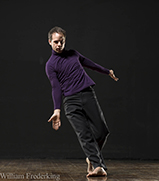
The Dance COLEctive performing “Moving Stories”, Photo by William Frederking

In terms of pooling resources, can you give a few examples of specific things you will be sharing?

Well, first and foremost, we are sharing ideas, knowledge, connections and trust. Not that we did not want to do that before but now we really have the space to do that, and the brainpower. All of these things take time, energy and thoughtful progression. Ultimately we will have a shared email list of patrons that we can use individually and for ongoing FlySpace events. We have several ideas related to technology that we are going to explore throughout our next phase of development. These ideas are related to data gathering and management, ticketing, marketing, social media and actively engaging with our patrons. So the sky is the limit!

The FlySpace Dance Series is a joint performance effort at the Jay Pritzker Pavilion in Chicago. How did the four of you work together to make this event happen?

We worked together to submit a proposal to the city, knowing all along that we wanted to make sure when we launched officially that we did what we do best – making work and performing. We were fortunate to be offered two weekends on the Pritzker Stage. Absolutely no way we could pass that up. Then, ultimately, how we divided the presentation into two companies over two weekends came down to the ways in which we wanted to use the space and the desire to put forward a substantial chunk of work to represent each company, and its aesthetic, fully.

As FlySpace evolves, how will the four of you make decisions about its scope and direction?

We have really been treating FlySpace like making a dance. The process around any good collaboration has flexibility, improvisation, happy surprises and failures. Ultimately we have an idea and as it unfolds and grows we will shape FlySpace with intuition and luck. That luck is sometimes finely calculated and sometimes just about being in the right place at the right time. It is a lot like flying…

The FlySpace Dance Series runs from April 5th through April 14th at the Jay Pritzker Pavilion in Chicago. Tickets are available at brownpapertickets.com or by phone at 773-871-0872.

0