Music & Dance

Music & Dance: Finding Music

by John Nevin

For most choreographers, finding music for a new work isn’t all that difficult, at least not at first; in many cases a new work may actually be inspired by a specific piece of music, and many choreographers have a long list of tracks they would like to choreograph to. Yet even if finding some of the music isn’t difficult, what can really be a problem is finding the rest of it. The first article in this series talked about how different the two steps in choosing music can be; that finding music is a personal, almost unconstrained process, while arranging that music into an effective score is a much more practical challenge.

You can really choose any kind of music to choreograph to, but as soon as you do, that music begins to shape the rest of the work. Sooner or later there has to be a transition from the purely personal choice of what inspires you to the more restricted choices of what will inspire your audience and your dancers, and what will go with the music you’ve already chosen.

None of that matters until you have a place to start, and on a practical level, the ways you find music, and the places to find it, are much the same whether you’re looking for music for a brand new work, or searching for that last section to complete your score. Besides the sites mentioned in the first article in this series (classical.com, junodownload.com, mondomix.com and beatport.com), there are several other approaches worth thinking about. One of them would be to subscribe to a streaming service, which doesn’t cost much at all. This gives you an important ability to listen to tracks all the way through, instead of just to excerpts, which becomes an important consideration when you have to arrange your music into a successful sound design. When you find something you like at one of those sites (napster.com, rhapsody.com, and classical.com has their own in-site), most of them make it easy to buy a legal copy. (Please don’t steal it, either by going to one of the illegal music sites that Google will be happy to guide you to, or by copying it from somebody you know.)

Beyond the download and streaming sites, there is another legal space for music discovery that is almost completely unknown to choreographers — the under-the-radar artist sites. Bandcamp.com and soundcloud.com are both well worth finding. At Soundcloud, you need to be careful because some of the tracks are not uploaded by the artists or their labels, but many are, and in many cases are available for free download. There’s also a brand new legal music store at vimeo.com, and because Vimeo is a film and video site, there’s a tremendous choice available there of soundtracks that can work well for choreography. In any case, finding that first piece of music, whether for a work you’re about to begin, or just for some possible future project, is best done with an open mind and plenty of time.

Read more

2

Review: Ballet Etudes By Robert Long

This was my first exposure to a Robert Long CD and I really enjoyed it. Many fellow teachers have expressed the fact that they enjoy his music for ballet class, and I have to agree–it’s very good!

I always “test” CDs out on my adult ballet class. They are an eclectic group of students, and I received some nice comments on the music. The tracks were arranged well, and best of all, labeled well. As an instructor, I found the way he used the liner notes to be very helpful. They were broken down into categories that made sense for the way I teach: at the barre, centre practice, pirouettes, adage, petit allegro, batterie and grand allegro. It made it very easy to arrange my class, and it was a detail that was much appreciated.

The music itself is passionate and pretty, and there are plenty of tracks to choose from since the CD offers many selections. Since I have a fairly large class, some of the tracks in the centre were a bit short for my purposes, but I doubt that would be true for all teachers. There are 48 original selections in all for barre and centre practice. I listened to everything here and found each track to be well-suited to ballet class exercises.

It is obvious that Mr. Long has been involved with the dance community for a long time–his intuitive sense of planning the CD and its selections showcases this fact quite well. I’m looking forward to hearing more from him and using his music for class well into the future.

It’s worth noting that Mr. Long offers music on iTunes and Amazon as well, for those who prefer that format.

Visit Robert Long’s site for more information about him and his music.

Read more about this artist in the 4dancers “10 Questions With…” interview.

0

Review: Music For Movement And Imaginations by Richard Maddock

This CD was such a lovely surprise!

Richard Maddock has created an original album of dance music for children ages 3 and up, and it would be a great addition to any ballet teacher’s collection. Right away from the first track I knew this was going to be a collection of music that I loved. It’s just so pretty!

Music for Movement and Imaginations lives up to its name. The tracks here range from dreamy to daring, and there are 43 of them to choose from, giving dance teachers plenty of raw material to work with when it comes to dance making. Maddock has labeled these well too–including some hints for usage in the titles, such as “run and freeze”, “skips”, “gallops” and “run like the wind”. Ballet terminology is present here too, and some tracks are labeled with “port de bras” or “jumps and allegro” accordingly. Very helpful.

I was actually taken aback at how beautiful this CD is. Maddock has a talent that shines through, and it is kind of nice to have a collection of dance music for children that doesn’t include all the “typical” fare. Rather than go the traditional route with kids dance music, Maddock has chosen to push the envelope and create tracks specifically with them in mind. I love it!

That said, I do think that this CD could be used for other ballet classes as well, and quite frankly, the music is so pretty that I have put it on in the background when I want something on that is soothing. While not every track is quiet or low-key, the overall album is very nice to listen to.

To learn more about Richard Maddock, or to purchase one of his CDs, please visit his website.

0

Choosing Music For Choreography

by John Nevin

Choosing music for choreography is one of those things that seems so simple, but always ends up being complicated. That’s not because people underestimate the process, it’s because the process is at the same time very simple and very complicated — and that’s only the first of several contradictions that a choreographer faces when trying to choose music for a new work. To do so successfully, you have to ignore your audience, and you have to think only of your audience. You have to have to forget the whole work and think only of the parts, and then you have to do exactly the opposite. You have to trust yourself completely, and not trust yourself at all.

Fortunately, there’s a sequence to all of this, and not a very complicated one at that. There are two parts to the process of choosing music for choreography — finding the music, and then arranging it. In many ways, the way to succeed in one part is to do the opposite of what succeeds in the other.

Finding the Music

What are you looking for when you’re searching for music for a choreographic work? You’re looking for inspiration. You’re either looking for music that will inspire movement and design, or you’re looking for music whose inspiration complements the movement and design that you already imagine. In either case, this is the time to forget your audience, your sponsors, and especially your peers, and trust yourself.

Read more

1

Review: Ballet Studio Inspirations: Volume Three

Ballet Studio Inspirations is a comprehensive CD of piano music for ballet class by Richard Maddock. There are 43 original compositions on the album – 20 for the barre and the rest for centre work. Putting the word “inspirations” in the title is appropriate–as the music really does inspire.

Maddock is truly an artist–his work is just beautiful, and I am looking forward to using it in my adult ballet class. Although it was developed for a pre-professional class, this CD would work well for most levels, and it is a refreshing departure from the standard ballet class music. There is more of a gentle, yearning feel to Maddock’s slower tracks that should coax out feeling from your dancers–even at the barre.

The more upbeat tunes are lively and well-played too, but I believe Maddock is at his best when the more lyrical music is running through his fingers. All-in-all this album of tracks created for ballet class is something that would round out any dance teacher’s collection nicely. When you are in the mood for something that will motivate your dancers to experiment with phrasing and emotion, this is the CD you will reach for. The port de bras music is especially lovely.

I found Maddock’s CD to be an unexpected and wonderful addition to my collection of ballet class music. It’s really nice to have some original compositions to include–especially when they are arranged and played as well as they are here. It can be challenging to find great CDs for ballet class. This is one of them.

Maddock has sample tracks on his website and you can also purchase CDs there. In addition, his work can be found on Amazon and iTunes if you are looking for digital downloads.

Disclosure

0

10 Question With…Marina Surgan

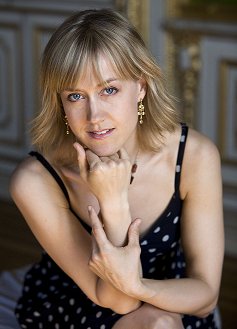
Marina Surgan

Today on 10 Questions With… we talked with Marina Surgan….

1. Can you tell readers a bit about how you got into music?

Getting into music was very easy and natural for me. Everybody in my family played an instrument and to keep the family tradition my mother sent me to a piano teacher when I was seven years old. It was a “must” in my family to have a subscription to Philharmonic concerts, to the Opera, and to Ballet Theatre. When I was nine years old I was accepted to the very famous music school for gifted children named after Professor Stolyarsky in Odessa, and I continued my education in Moscow’s Pedagogical Institute (former USSR) as a Soloist, Concertmaster and Piano Teacher. I was also composing music.

2. How did you get involved with the dance world?

When I was  seven I  thought that the minute I put on some pointe shoes I’d be able to spin and run across the stage as easy as those magical ballerinas. One day I persuaded my mom to buy me a pair of pointe shoes. I couldn’t wait to get home and try them on, but when I put them on the excruciating pain at once destroyed all my dreams of becoming a ballerina. I decided that it was better for me to stick with piano, as it wasn’t that painful.

When we emigrated to Toronto I met a former dancer from the Igor Moiseyev Dance Company who was looking for an accompanist. She asked me if I could play by ear – folk music. This is where I gave thanks to God for the gift of perfect pitch and improvisation. This is how I got involved with the dance world.

3. You have composed music for the Cecchetti Grade Examinations – what was that like?

It was in 1980, Carol Chadwick who was Vice Principal of ballet at Canada’s National Ballet School at that time asked me if I could compose new music for the Cecchetti Grade Examinations. I didn’t know grades music so I told her that I needed a studio with a student and teacher who could demonstrate each exercise for me – so that I could improvise on the spot and everything would be videotaped.

I should proudly say that I did quite a good job and didn’t have to edit any of my compositions. I just had to score all the music that was recorded by videotape and it was subsequently published by the Canadian Branch of the Cecchetti Society in 1983.

4. You have also held workshops for accompanists- what are those like?

Read more

0

Review: The Magic Wand by Lisa Harris

When I began building my ballet music collection, Lisa Harris was one of the first dance class CDs that I bought. I still have it (and others by her) today.

Although I don’t teach little ones any more, if I did, The Magic Wand would be something I would enjoy using. With 30 tracks to choose from, there is plenty of variety, no matter what type of creative movement exercises you have planned. There are slow tracks, perfect for “princess” type dance, medium tempo tracks that are good for marching, and high-energy tracks that lend themselves to big movements or group dance.

You’ll hear favorites such as “When You Wish Upon A Star”,”Skip to My Lou”, “Take Me Out To The Ballgame” and “Spoonful of Sugar” here, making it easy to plan dances without having to first familiarize yourself with the music. Harris, as always, plays beautifully and clearly, ideal for dancers.

Take advantage of tracks like “The Hokey Pokey” and “I’m A Little Teapot” to teach more well-known movements, and use the rest of the tracks to inspire your imagination. This album is really geared for pre-ballet classes, and it provides just the right kind of music for the little dancers. Any ballet teacher who has tots would love this CD for their collection.

Harris offers a wide range of music, so even if you aren’t interested in pre-ballet music, you can take a look at what she has for grown ups too. Her website has a full range of offerings, including some digital downloads and a boxed set of CDs for teachers.

Learn more about Lisa Harris or purchase a ballet class CD on her website.

0

Coming Up On 4dancers…

From time to time I like to do a little preview of things that will be coming up on 4dancers, and this week I have a lot to share! In addition to the new column we have “The Business of Dance” by Lizzie Leopold, we are also adding two new features in the upcoming weeks….

Join us for “Finis” – a new monthly column that will feature a dance photo at the end of the month, and “Music & Dance” – a column that will highlight a composer/producer’s take on the relationship between sound and movement. You’ll be meeting both of the new contributors soon in our “10 Questions With…” series. And good news for those of you who have enjoyed our SYTYCD contributor, Kimberly Peterson’s writing…she’ll be staying on to write more for 4dancers on other topics…

Also–look for more interviews (on Mondays) and dance music reviews (on Wednesdays) as we finish up the summer and settle into fall. I am going to be taking more time to work on this blog, so expect to see more content overall as we take 4dancers to the next level.

Let us know if there is something you’d like to hear more about, and in the meantime, we’d just like to thank you for taking the time to visit. If you haven’t yet taken the time to link up with us on Facebook and Twitter why not join us now? There’s going to be a lot going on!

0